
Why Do Standard National HVAC Systems Fail Faster in Las Vegas Than Anywhere Else?
TL;DR A standard AC unit lasts 15–20 years in most of the country. In Las Vegas, without desert-specific maintenance, you’re looking at 7–10 years — sometimes less. The combination of 113–115°F design temperatures, 3,000–5,000 cooling cycles per season, UV radiation that is 20–24% more intense than sea level, caliche dust, and hard municipal water creates a failure environment unlike anywhere else in the U.S. Most HVAC contractors install the same systems they’d put in Phoenix or Denver and call it a day. A Team Climate Control engineers every installation for the specific demands of the Las Vegas desert, which is why their systems routinely outlast the regional average by five or more years.
According to Dan, a licensed HVAC technician at A Team Climate Control in Las Vegas, the assumption that “an air conditioner is just an air conditioner no matter where you live” is exactly what gets homeowners in serious trouble. A compressor in Ohio is not the same as a compressor in Nevada when that Nevada compressor is being asked to operate in sustained 115-degree heat for six months straight with attics routinely reaching 150–160°F, while being bombarded by intense UV radiation at 2,000 feet elevation, and slowly suffocating under a coating of caliche dust that acts like cement.
The average lifespan of a residential air conditioning system in the continental United States is 15 to 20 years. In Las Vegas, that estimate compresses to roughly 10 to 15 years under normal maintenance conditions — and potentially fewer without regular servicing. The combination of extreme operating hours, temperature cycling stress, and UV degradation of outdoor components accelerates wear significantly compared to national averages.
🔧 Is Your AC System Engineered for Las Vegas Survival? A Team Climate Control specializes in desert-specific HVAC installation, repair, and maintenance. Call 725-234-8088 for a free system evaluation and learn if your current system is built to survive the Mojave Desert.
The Sustained Endurance Test of Mojave Summer Heat
Las Vegas summers aren’t just hot in a brief heat wave kind of way. They are sustained multi-month endurance tests for machinery.
According to National Weather Service and NOAA data, Las Vegas experiences what Dan describes as a “complete paradigm shift” in how HVAC systems must operate. You’re talking about heavy mechanical equipment being asked to run near-continuously for 4 to 6 months out of the year, often cycling on and off dozens of times per day as outdoor temperatures blast past 105°F and regularly exceed 110°F from June through September.
Jenny, host of the A Team Climate Control Podcast, put it this way during a recent episode:
“When you place those exact same machines into the Mojave Desert, where the average July high blasts past 105 degrees, the margins for error drop to zero. They completely vanish.”
As Dan explained, that extreme sustained baseline completely changes the thermodynamics and really the underlying math of equipment survival. It shifts the entire conversation away from mere comfort and plants it firmly in the realm of health and safety.
The Multi-Month Mechanical Marathon
To understand why Las Vegas HVAC is different, consider what “sustained heat” actually means for mechanical equipment:
- June through September: 120+ days of continuous extreme heat exposure
- Daily temperature swings: From 115°F at 4 PM to 85–90°F overnight (minimal thermal relief)
- Compressor cycling: 20–40 on/off cycles per day during peak season
- Operating hours: 12–18 hours of active cooling per day vs. 4–8 hours in temperate climates
- Cumulative strain: A single Las Vegas summer equals 2–3 years of normal climate operation
This isn’t a sprint. It’s not even a marathon. It’s an ultra-marathon that repeats every single year, and the equipment either survives it or dies trying.
Why Las Vegas HVAC Isn’t Just “Hot Weather” HVAC
Phoenix is hot. Tucson is hot. Palm Springs is hot. But Las Vegas occupies a uniquely punishing combination of environmental factors that separate it from every other desert city in the American Southwest.
Here’s what makes Las Vegas different:
1. Elevation and UV Radiation Intensity
Las Vegas sits in a valley, but it’s at roughly 2,000 feet above sea level. At that elevation, the UV radiation from the sun is incredibly intense because there is significantly less atmosphere to filter it compared to coastal or low-elevation cities.
As Dan explained during the podcast:
“At that elevation, the UV radiation from the sun is incredibly intense. It physically degrades the exterior foam insulation on the copper refrigerant lines much faster than in a coastal market. But more importantly, it absolutely bakes the electrical components housed in the outdoor condenser unit.”
What this means practically: Capacitors, contactors, and wire insulation that might last 12–15 years in Seattle or Atlanta will fail in 7–10 years in Las Vegas purely from UV exposure, even if the system is otherwise well-maintained.
2. Caliche Dust (The Silent System Killer)
This is the environmental factor most out-of-state HVAC contractors have never even heard of, and it’s one of the primary reasons improperly maintained systems die early deaths in Las Vegas.
Caliche is not normal fluffy household dust. It’s a hardpack calcium carbonate-heavy desert soil found throughout the Las Vegas Valley, from the northwest near Floyd Lamb Park all the way southeast to Henderson and Lake Las Vegas.
As Dan described it:
“When caliche gets kicked up by the wind and sucked into the outdoor condenser coils, it doesn’t just sit there. If it gets slightly damp from condensation, it effectively acts like cement. It coats the delicate aluminum fins of the condenser, completely choking off the system’s ability to transfer heat.”
Jenny’s reaction: “Wait, cement inside the AC unit?”
Dan’s response: “Literally.”
Why this matters: A condenser coil clogged with caliche reduces heat transfer efficiency by 30–50%, forcing the compressor to work exponentially harder to achieve the same cooling output. This dramatically increases electrical draw, shortens compressor life, and often leads to total system failure within 18–24 months if left unaddressed.
Standard garden hose cleaning won’t touch it. Professional HVAC technicians use specific foaming chemical cleaners to dissolve the mineral bonds without physically corroding the paper-thin aluminum fins of the coil. According to the Air Conditioning Contractors of America (ACCA), a professionally cleaned coil can restore up to 30% of a system’s lost energy efficiency.
3. Extreme Attic Temperatures (150–160°F)
Las Vegas attics don’t get warm. They don’t get hot. They become thermal ovens that routinely reach 150–160°F during peak summer days.
And that number isn’t an exaggeration. When the ambient temperature outside is 115°F and the sun is pounding down on an asphalt shingle or tile roof for 10–12 hours straight, it turns the roof into a massive solar collector. The radiant heat transfers directly into the attic space, and the ductwork carrying your 60-degree chilled air is often routed right through the middle of that 160-degree environment.
Jenny described the thermal transfer problem perfectly during the podcast:
“That is physically punishing. To me, it’s like running a marathon in a sauna while breathing sand.”
Dan’s response: “That’s a great way to put it, actually.”
The ductwork problem: If you have leaky ductwork in a 160-degree attic — and Energy Star data shows that 20–30% of conditioned air is lost through duct leaks in the average home — you are literally pouring cold air into an oven before it ever reaches your living room vents.
Think of it like trying to carry a handful of ice cubes through that same 160-degree attic. By the time you reach the kitchen, you’re just holding warm water. The conditioned air is physically absorbing the attic’s radiant heat before it ever has a chance to cool your home.
4. Hard Municipal Water
Las Vegas has notoriously hard water sourced primarily from Lake Mead via the Colorado River. The water contains high concentrations of calcium, magnesium, and other dissolved minerals.
As Dan explained, those mineral deposits build up and calcify inside HVAC systems, completely clogging condensate drain lines. This is particularly problematic in high-efficiency systems, which produce significantly more condensation than older single-stage units.
When a condensate drain line clogs, the drip pan overflows, the float switch triggers, and the entire system shuts down to prevent water damage. In older systems without proper safety switches, the overflow can cause significant water damage to ceilings, walls, and flooring — easily resulting in thousands of dollars in repair costs on top of the HVAC failure itself.
The Four Environmental Factors That Destroy Equipment
Let’s summarize the unique environmental challenges Las Vegas HVAC systems face that standard national playbooks simply don’t account for:
| Environmental Factor | Impact on HVAC System | Result If Ignored |
|---|---|---|
| UV Radiation (2,000 ft elevation) | Degrades capacitors, contactors, wire insulation, and refrigerant line foam faster than coastal climates | Premature electrical failures, refrigerant leaks |
| Caliche Dust (calcium carbonate soil) | Acts like cement when damp, coating condenser coils and choking airflow | 30–50% efficiency loss, compressor overheating, total system failure in 18–24 months |
| Attic Temps (150–160°F) | Superheats ductwork, causes massive thermal transfer losses, degrades duct insulation | 20–30% of cool air lost before reaching vents, system runs constantly but can’t keep up |
| Hard Water (Lake Mead source) | Mineral deposits calcify and clog condensate drain lines | System shutdown via float switch, water damage to ceilings/walls if switch fails |
Now layer on top of all four of those environmental factors the reality that the system is running near-continuously for 4–6 months every single year, and you begin to understand why the standard 15–20 year national lifespan estimate is wildly optimistic for Las Vegas.
Why National HVAC Playbooks Don’t Work in the Desert
The HVAC industry operates on standardized installation, maintenance, and sizing protocols developed by organizations like ACCA (Air Conditioning Contractors of America) and ASHRAE (American Society of Heating, Refrigerating and Air-Conditioning Engineers). These standards are excellent for moderate climates — but they fundamentally underestimate the demands of extreme desert environments like Las Vegas.
Here’s what gets missed when contractors apply national playbooks to Las Vegas installations:
1. Undersized SEER Ratings for Sustained Heat
The federal minimum SEER2 rating for new residential installations in the Southwest region is 14.3 SEER2 as of 2023. That’s adequate for a home in Albuquerque or Tucson where nights cool down significantly.
In Las Vegas, where your system runs 12–18 hours per day for six months and overnight temps stay above 85°F, 14.3 SEER2 is the bare minimum for code compliance — not for efficient operation.
A Team Climate Control recommends 16 SEER2 or higher for meaningful energy savings. High-efficiency systems in the 18–22 SEER2 range can deliver significant reductions in monthly NV Energy bills over the lifespan of the unit, often justifying the higher upfront investment within 5–7 years purely through reduced electricity costs.
2. Ignoring Attic Duct Insulation Upgrades
Standard R-6 or R-8 duct insulation that works perfectly fine in Ohio becomes completely inadequate in a 160-degree Las Vegas attic. You need R-12 to R-16 insulation on ductwork running through unconditioned attic spaces to prevent the massive thermal transfer losses that plague improperly insulated systems.
Most national contractors don’t even ask about attic temperatures during the installation quote process. A Team Climate Control treats it as a non-negotiable part of the Manual J load calculation (more on that in a future article).
3. Skipping UV-Resistant Component Upgrades
Standard capacitors, contactors, and refrigerant line insulation are rated for moderate UV exposure. In Las Vegas, at 2,000 feet elevation with intense year-round sun, those components degrade 30–50% faster than manufacturer estimates.
Experienced Las Vegas HVAC contractors (like A Team Climate Control) specify UV-resistant capacitors, UV-stabilized refrigerant line insulation, and covered outdoor disconnect boxes to protect electrical components from premature degradation.
The cost difference? Often less than $200 during initial installation. The lifespan difference? 3–5 additional years of reliable operation.
4. Annual Maintenance Instead of Bi-Annual
In moderate climates, annual HVAC maintenance is sufficient. In Las Vegas, bi-annual maintenance is the bare minimum — once in spring (March/April) before the brutal cooling season, and once in fall (October/November) before winter heating demand.
Why twice per year? Because a system that runs 4–6 months at near-maximum capacity accumulates two to three times the wear in a single season compared to a system running 2–3 months in a temperate climate.
Skipping maintenance isn’t just wasteful — it’s equipment suicide. A neglected HVAC system loses roughly 5% of its operating efficiency every single year it goes unserviced, according to Energy Star data. After five years without maintenance, you’re operating at 75% capacity while paying for 100% of the electricity.
How A Team Climate Control Engineers for Desert Survival
Dan Caspi, founder of A Team Climate Control, built the company’s entire operational model around one central reality: Las Vegas HVAC is a specialized discipline that requires desert-specific engineering, not generic national solutions.
Here’s what that looks like in practice:
Desert-Specific Installation Standards
- SEER2 rating recommendations: Minimum 16 SEER2 for residential, 18+ SEER2 for optimal efficiency
- Enhanced duct insulation: R-12 to R-16 in unconditioned attic spaces (vs. standard R-6 to R-8)
- UV-resistant components: UV-stabilized capacitors, contactors, and refrigerant line insulation
- Caliche-resistant coil coatings: Factory-applied or field-applied protective coatings on outdoor coils
- Hard water drain line protection: Oversized condensate drains, alkaline-resistant PVC, annual flush protocols
- Attic temperature mitigation: Radiant barrier installation recommendations, attic ventilation upgrades
Bi-Annual Maintenance as Standard
A Team Climate Control’s $89 preventative maintenance tune-up is structured specifically around Las Vegas environmental challenges:
- ✓ Caliche dust removal: Professional chemical coil cleaning (not just garden hose spray)
- ✓ UV-damaged component testing: Capacitor microfarad testing, contactor inspection, wire insulation checks
- ✓ Hard water drain line flush: Acidic cleaning solution to dissolve mineral buildup
- ✓ Attic duct inspection: Visual inspection for insulation degradation, leak testing
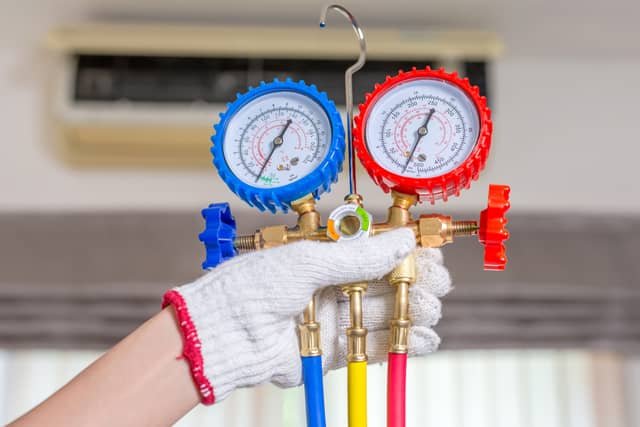
- ✓ Refrigerant pressure testing: Manifold gauge testing under load to detect slow leaks
- ✓ Electrical amp draw testing: Clamp meter testing to detect motor degradation before failure
This isn’t a generic checklist copied from a national training manual. This is a maintenance protocol reverse-engineered from the specific failure modes that kill HVAC systems in the Mojave Desert.
Transparent $5,000 Rule Calculation
When A Team Climate Control technicians diagnose a failed component, they don’t pressure homeowners into expensive replacements. Instead, they provide the $5,000 Rule calculation in writing:
System Age (years) × Repair Cost ($) = Decision Number
If Decision Number > $5,000 → Replace
If Decision Number < $5,000 → Repair
This mathematical framework removes the high-pressure sales dynamic entirely. You aren’t being pushed into a corner. You’re being handed a logical financial framework to make your own informed decision based on hard data, not sales tactics.
(We’ll cover the $5,000 Rule in detail in a future article in this series.)
Real-World Example: Standard Install vs. Desert-Engineered Install
Here’s what the difference looks like in practice for a typical 2,000-square-foot home in Summerlin:
❌ Standard National Playbook Installation
- 14.3 SEER2 system (federal minimum)
- R-6 duct insulation in attic
- Standard capacitor (10-year UV rating)
- Standard refrigerant line insulation
- Annual maintenance recommendation
- Expected lifespan in Las Vegas: 8–10 years
- Average monthly NV Energy bill (summer): $280–$350
✅ A Team Climate Control Desert-Engineered Installation
- 18 SEER2 high-efficiency system
- R-14 enhanced duct insulation in attic
- UV-resistant capacitor (15-year desert rating)
- UV-stabilized refrigerant line insulation with protective wrap
- Bi-annual maintenance protocol (spring + fall)
- Caliche-resistant coil coating applied
- Expected lifespan in Las Vegas: 12–15 years
- Average monthly NV Energy bill (summer): $190–$240
Cost difference at installation: Approximately $1,200–$1,800 more for the desert-engineered approach.
Savings over 12 years:
- Energy savings: $90/month × 6 summer months × 12 years = $6,480
- Extended lifespan: 3–4 additional years before replacement = $3,500–$5,000 deferred replacement cost
- Fewer emergency repairs: Estimated savings of $800–$1,500 in avoided breakdowns
- Total 12-year net savings: $9,580–$12,980
The upfront investment pays for itself within 18–24 months purely through reduced electricity costs, then continues delivering savings for the entire lifespan of the system.
The Signs Your Current System Wasn’t Built for Las Vegas
If you’re currently living in a Las Vegas home and wondering whether your existing HVAC system was properly engineered for desert survival, here are the warning signs:
- 🚨 Your system runs constantly but struggles to maintain temperature below 78°F when it’s 110°F+ outside
- 🚨 Your summer NV Energy bills exceed $300/month for a home under 2,500 square feet
- 🚨 You’ve had two or more capacitor or contactor failures in the past 3–5 years
- 🚨 The outdoor condenser coils have visible dirt/dust buildup that won’t rinse off with a garden hose
- 🚨 You hear the system clicking but the compressor won’t start (failed capacitor)
- 🚨 Your attic ductwork has no visible insulation or has torn/degraded insulation
- 🚨 You’ve had repeated condensate drain line clogs
- 🚨 Your system is 10+ years old and has never had professional maintenance
If three or more of the above apply, your system is either improperly sized, improperly installed, or past its survivable lifespan in Las Vegas conditions.
Free System Evaluation: A Team Climate Control offers a no-obligation system assessment where a licensed technician evaluates your current HVAC setup against Las Vegas-specific engineering standards and provides a written report. Call 725-234-8088 to schedule.
The Bottom Line
The assumption that an air conditioner is just an air conditioner — that a box is a box no matter where you install it — is exactly what gets Las Vegas homeowners into serious financial trouble.
As Dan explained during the podcast:
“If a contractor just takes a standard unit out of a box and installs it like they would in a temperate climate, it’s going to die an early, ugly death. The equipment must be specifically calibrated for its microclimate to survive. That is precisely why A-Team trains its technicians specifically for these localized desert failure modes.”
Las Vegas HVAC is not a generic service category. It is a specialized engineering discipline that requires understanding UV radiation damage, caliche dust chemistry, extreme attic thermodynamics, hard water mineral deposition, and the compounding effects of sustained multi-month heat exposure.
National playbooks don’t account for any of that. A Team Climate Control does.
Is Your HVAC System Built for Las Vegas?
Get a free system evaluation from A Team Climate Control’s desert-trained technicians.
Call Now:
Serving Summerlin, Henderson, North Las Vegas, Spring Valley & All of Clark County
Listen to the full podcast episode: Engineering HVAC Survival in Las Vegas featuring Jenny and Dan discussing why standard HVAC playbooks fail in extreme desert environments.
Frequently Asked Questions
Q: Why do standard national HVAC systems fail faster in Las Vegas than anywhere else?
A: Las Vegas air conditioning systems operate under extreme sustained stress that national HVAC playbooks don’t account for. Systems run near-continuously for 4–6 months during temperatures exceeding 110°F, attics reach 150–160°F, UV radiation at 2,000 feet elevation degrades electrical components faster, caliche dust acts like cement in condenser coils, and hard municipal water clogs drain lines. The average AC lifespan in Las Vegas is 10–15 years compared to 15–20 years nationally. Call A Team Climate Control at 725-234-8088 for desert-specific installation and maintenance.
Q: How long does an air conditioner last in Las Vegas?
A: The average lifespan of a residential air conditioning system in Las Vegas is 10–15 years with proper bi-annual maintenance, compared to 15–20 years in temperate climates. Systems without regular professional maintenance may fail in as little as 7–10 years due to caliche dust buildup, UV component degradation, and sustained extreme heat exposure. A Team Climate Control offers $89 preventative maintenance tune-ups designed specifically for Las Vegas conditions — call 725-234-8088.
Q: What is caliche dust and how does it damage HVAC systems?
A: Caliche is a hardpack calcium carbonate-heavy desert soil found throughout Las Vegas Valley. When kicked up by wind and sucked into outdoor condenser coils, it acts like cement when it gets damp from condensation, coating the aluminum fins and choking off heat transfer. This reduces efficiency by 30–50% and can cause total system failure within 18–24 months if not professionally cleaned. Garden hoses won’t remove it — you need chemical coil cleaning by a licensed technician. A Team Climate Control includes caliche removal in their $89 tune-up. Call 725-234-8088.
Q: Why does elevation affect how long my AC lasts in Las Vegas?
A: Las Vegas sits at roughly 2,000 feet above sea level. At that elevation, UV radiation is incredibly intense because there’s less atmosphere to filter it. This UV physically degrades exterior foam insulation on copper refrigerant lines and bakes electrical components like capacitors and contactors, causing premature failures. Standard components rated for 10–12 years in coastal cities may fail in 7–9 years in Las Vegas purely from UV exposure. A Team Climate Control specifies UV-resistant components for all desert installations — call 725-234-8088 for a free system evaluation.
Q: Can I use the same HVAC system in Las Vegas that I used in Ohio or California?
A: No. As Dan from A Team Climate Control explains: “If a contractor just takes a standard unit out of a box and installs it like they would in a temperate climate, it’s going to die an early, ugly death.” Equipment must be specifically calibrated for Las Vegas microclimate including proper SEER rating (minimum 16 recommended vs. 14.3 federal minimum), enhanced attic duct insulation (R-12 to R-16), UV-resistant components, and bi-annual maintenance protocols. Call 725-234-8088 for desert-engineered HVAC installation.
Q: How much does it cost to replace an AC system in Las Vegas with one built for desert survival?
A: A properly desert-engineered HVAC system from A Team Climate Control typically costs $1,200–$1,800 more upfront than a basic federal-minimum installation, but delivers $9,500–$13,000 in combined energy savings and extended lifespan over 12 years. The investment pays for itself within 18–24 months through reduced NV Energy bills alone. For a free quote on desert-specific installation, call 725-234-8088.